

Coming on December 16
Coming on December 23
Introduction
Franz Listz's interest in Goethe's Faust was prompted by an illustrious mediation, that of Hector Berlioz, who dedicated his Damnation de Faust to Listz in 1846.
The favor was returned by Liszt who dedicated to Berlioz the Faust Symphony.
Listz started toying with the idea in the 1840s but the work saw the light of day only a decade later. Liszt revised this "Symphony of 3 psychological characters" - more of this later - quite a few times, adding a final Chorus Mysticus in 1857, and fine-tuning it till 1880.
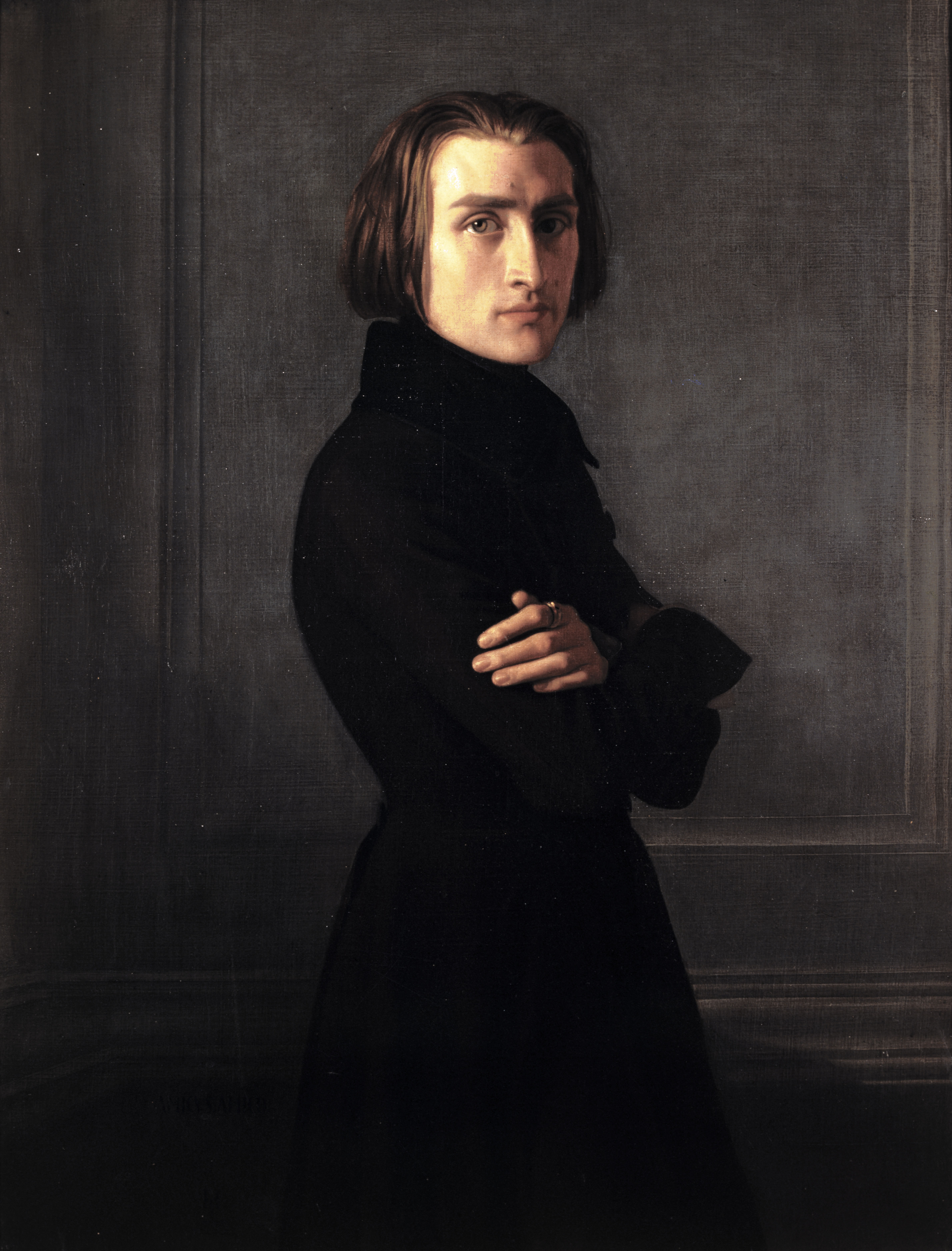
Heinrich Lehmann - Portrait of Franz Liszt (1839)
The word Symphony, in this case, needs to be interpreted in light of the experiments Listz was running in those years, in his ever-lasting attempt to break down barriers in all genres.
This is not a programmatic work in the sense that Berlioz's Symphonie Fantastique is, and not a symphonic poem either, a genre that Liszt himself had invented with the idea that the poetic subject would determine the form of a composition.
The Faust Symphony is more of a hybrid, similar to the Dante Symphony - which by the way you can find right here - in which some traits of the symphony (like different movements and the sonata form) intertwine with Liszt composing process of the symphonic poem, and, more in general, of his process of thematic transformation.
The symphony spans 3 movements, titled Faust, Gretchen (Marguerite), and Mephistopheles. Each movement is a psychological exploration of a character. Liszt achieves this by developing a musical idea and exploring its many nuances. A technique that Wagner transferred to his operas in the use of the Leitmotif. If you want a more recent comparison, John Williams used the same technique in the film's score for Starwars.
The structure of the symphony - one of the most interesting and original of the 19th century - is built on a limited number of themes. Faust, the most complex character, is developed through 5 different and contrasting themes; Gretchen has 2 themes complementing one another; Mephistopheles - and here you can really see the devious genius of Liszt - has none. Rather, he robs 4 out of 5 of Faust's themes and satanically distorts them.
Faust Symphony - Analysis
Movement 1: Faust
Should you need a score you can find one here.
This large-scale movement (usually lasting around 30 minutes) is a very loose sonata-form with a short central development and an extended recapitulation. The basic key of the Symphony (C major) is already somewhat blurred by the opening theme composed of arpeggios and augmented fifths. This theme evokes the dark Faust, a dreamer in a constant search of truth and knowledge: doubts, metaphysical questions, restlessness, contempt for the world and for oneself as expressed in Goethe's initial monologue.
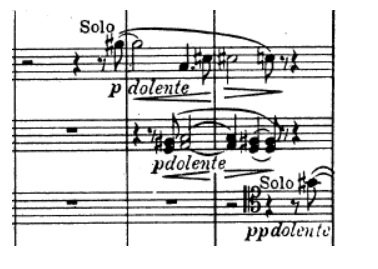
And a sidekick: if you look at the theme, you'll realize it anticipates Schoenberg's twelve-tone ideas. The theme is presented in this slow introduction by the violas and the cellos with mute

The answer is a second theme, poignant, complementary to the first, and built on 3 different motifs: a descending interval of a major 7th followed by an ascending one of major 3rd (presented by the oboe and clarinets); a sighing figure, in the strings; and a descending scale, very chromatic, played by the clarinet and the bassoon.
Due to the systematic chromatism, the home key of C major, remains undefined.
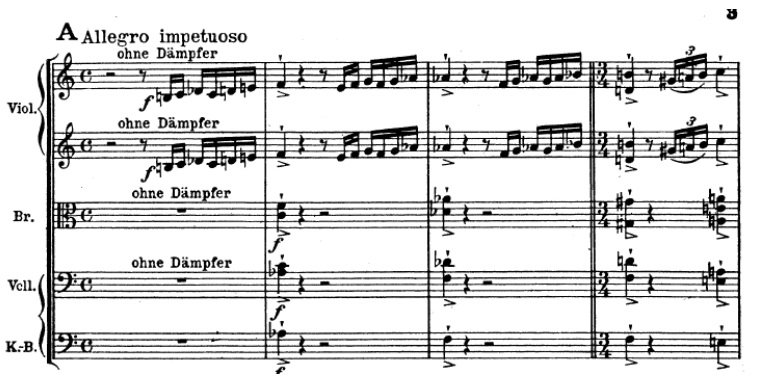
The episode is repeated in its entirety, leading us to the Allegro Impetuoso, which is characterized by fast ascending figures. Notice the insistence of the triton, the interval also known as Diabolus in musica (devil in music) because it was notoriously difficult to sing. Here it represents Mephistopheles: for Liszt, since the beginning, Faust cannot be imagined without Mephistopheles, his diabolical double, his opposite, his negative.

Oops...
This content is available for free with all memberships.
Already a member? Login here.
Not a member yet? Subscribe today and get access to more than 80 videos, scores analysis, technical episodes, and exercises.
Download the eBook (epub format) with the analysis of all 3 movements.



![Bruckner - Symphony 8 Movement 4 [Analysis]](https://gianmariagriglio.com/wp-content/uploads/2022/04/Bruckner-Symphony-n.8-Analysis.jpg)
0 Comments