

Introduction
The Romanian Folk Dances is a set of 6 dances originally written for piano in 1915. Bartók himself made a version for small orchestra a couple of years later while some of his friends wrote adaptations or transcriptions for different ensembles: for example, Arthur Willner for string orchestra only and Zoltán Székely for violin and piano.
The music comes from original melodies and tunes from Transylvania which Bartók heard (and recorded) himself played on fiddle or shepherd's flute.
Bartók had an interest in folk music for most of his life, and a lot of his works turn around it. He made extensive studies, recordings, analytical researches on the subject and was one of the founders of comparative musicology, which later became ethnomusicology.

Béla Bartók in 1927
Bartók emphasized the multi-ethnic origin of his own works in many of his lectures and letters but avoided explicit references to any nationalism. The original title of the Romanian Folk Dances included "from Hungary": this part was eliminated by Bartók himself when Transylvania became part of Romania in 1920.
A few years later, seeing the original title on the Universal publication of Székely's transcription, Bartók warned the editor that while such a title would please Hungarians at home, Romanians would probably take offense in the "from Hungary" reference.
The will to maintain and, actually, underline certain key aspects of folk music and their ties to different countries/people comes through in many of Bartók's papers on the subject. And, naturally, in his compositions.
He rarely used key signatures, though the 1971 edition of these dances does have them. All dances are based on modal scales: Aeolian, Dorian, Phrygian, Lydian, even the Arabic scale is used.
Rumanian Folk Dances n.1
Stick Dance
Should you need a score you can find one here.
The melody of the first movement, according to Bartók, came from the village of Mezőszabad in Transylvania, and he first heard it when two gypsy violinists were playing it.
The second violins, violas, cellos, and basses open with a heavy rhythm representing the stomping of feet. 4 bars later 2 clarinets in unison, and the first violins come in with the melody.
The mode of this first dance - centered on the A - moves from Dorian to Aeolian with a variation on the Phrygian cadence at the end of the phrase (a variation as the Phrygian cadence - the one that from a minor scale resolves on a major chord - is usually employed on a first inversion while Bartók here uses it on the root chord).
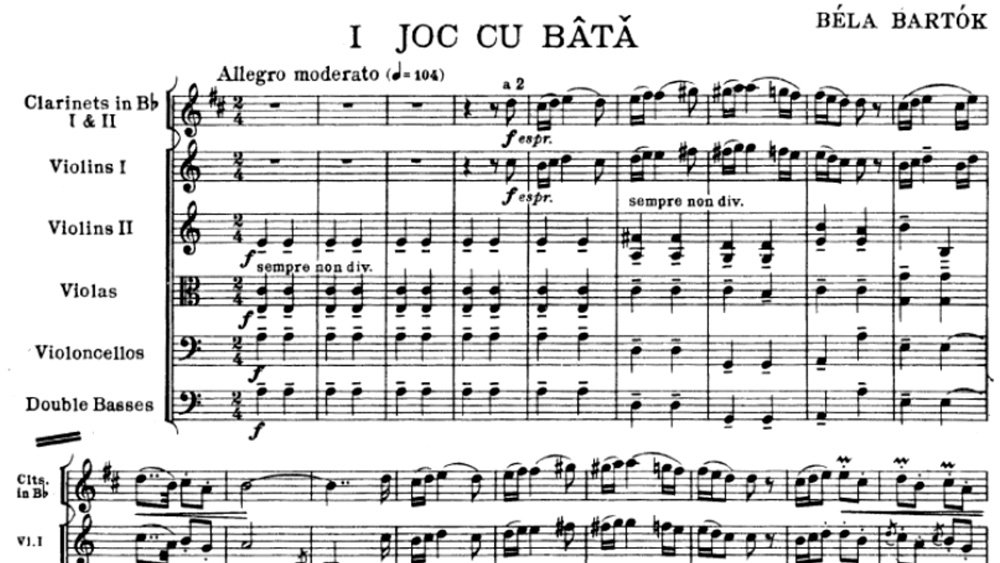
The structure is very simple: the first phrase is repeated, almost identical - notice the bass line on bar 16 - and then a second phrase answers, also repeated
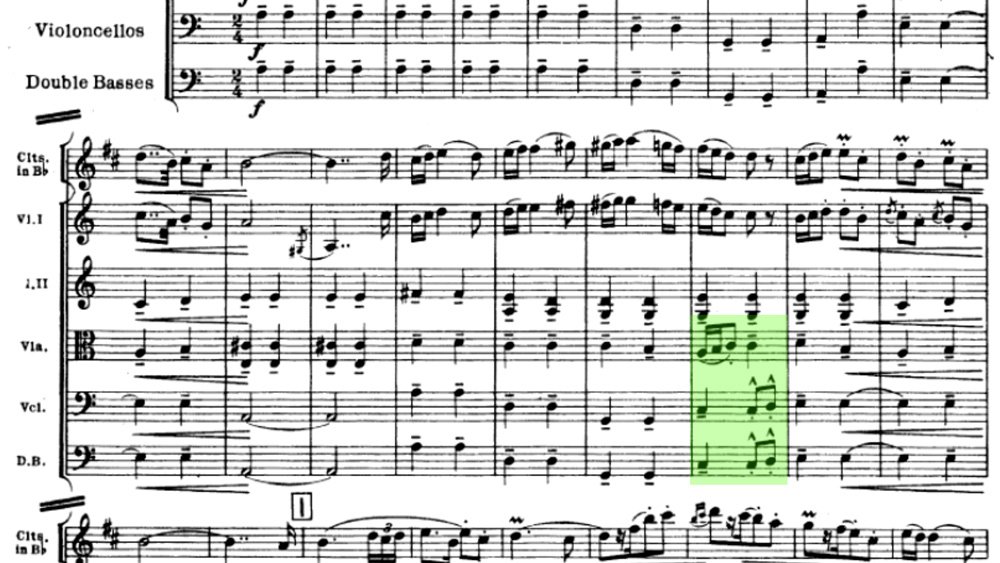
Look at the difference in the dynamics and the harmony in the repetition of the second phrase. Bringing out these little details is what really makes a difference in the interpretation of the piece
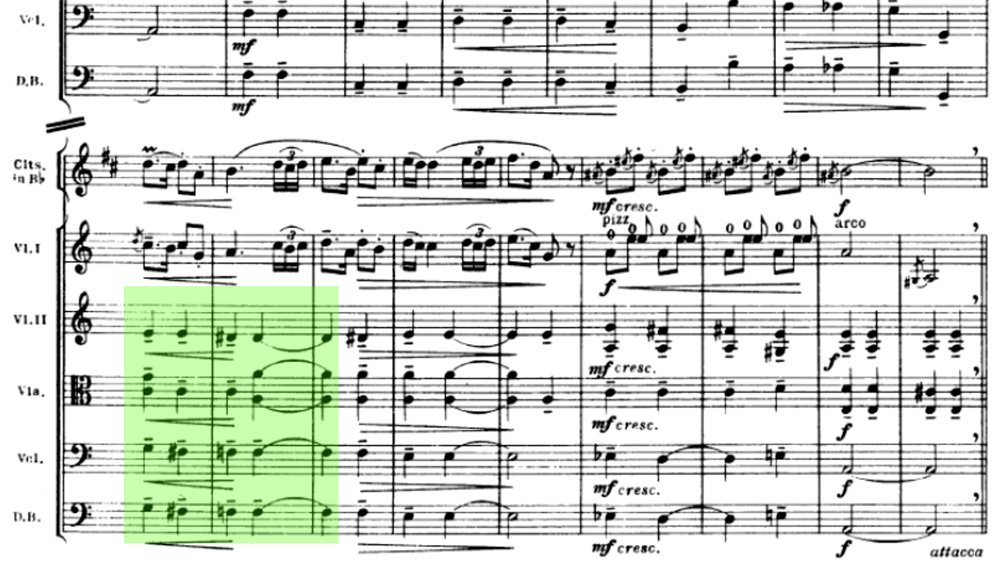

Oops...
This content is available for free with all memberships.
Already a member? Login here.
Not a member yet? Subscribe today and get access to more than 80 videos, scores analysis, technical episodes, and exercises.
Rumanian Folk Dances n.2
Belt Dance
The second movement is a typical dance from Romania called Brâul, for which traditionally a sash or a waistband was used. This melody came from Egres, in the Banat region.
This dance centers around a D Dorian. The strings offer a pizzicato accompaniment while the clarinet takes the lead with the melody

The structure is again very simple: A-A1. The second time around the clarinet plays the melody an octave higher and is doubled by the first violins while the accompaniment is now played with arco
Technical tip
The main characteristic of these dances is their freedom: this one for instance needs some push and pull to come alive. When you do study this one by yourself try to sing it in different ways. It will help you in bringing out the inner nuances of the musical line.

For a technical analysis, take a look at this other video
Rumanian Folk Dances n.3
In One Spot
The third dance comes also from Egres. The atmosphere is very static, reflecting the title. Violins and violas set the stage, sustained in the harmony by the clarinets with repeating open fifths chords in B.
B is, in fact, the key center of this third dance, evolving around the Aeolian mode with an augmented second interval, typical of the Arabic scale.
The piccolo enters a few bars later with a melody that keeps turning on itself characterized by a clear Arabian influence

After a repeat, the second phrase is exposed while the atmosphere remains the same. Notice the accent in the clarinets and the strings
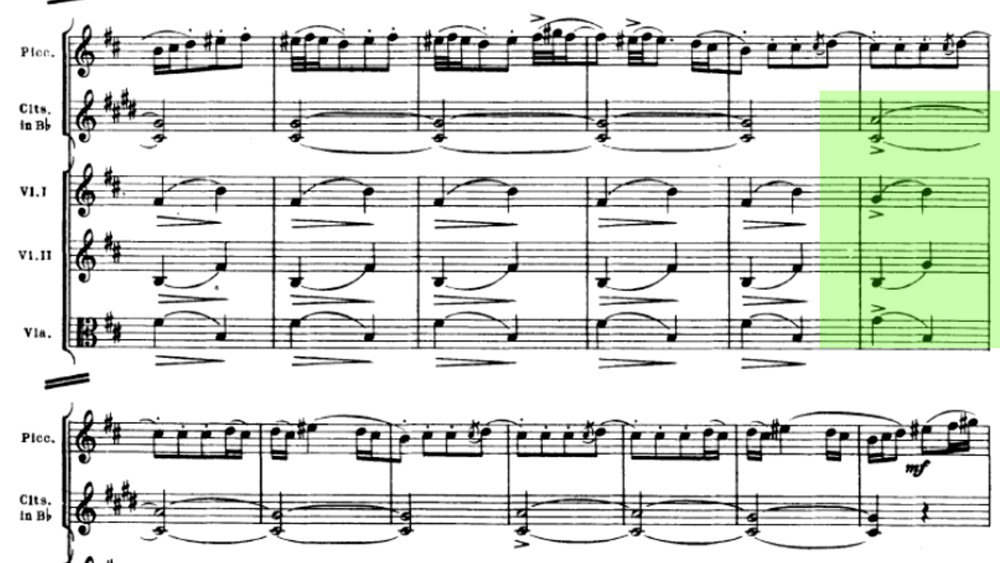
The second half of this dance sees the entrance of the cello in the accompaniment while the piccolo keeps the lead. Notice that the cello is playing the mid-high register not to add too much weight to the general sound. The dynamic moves to a mezzoforte but we soon are back to a piano dynamic and to the second phrase of the first section
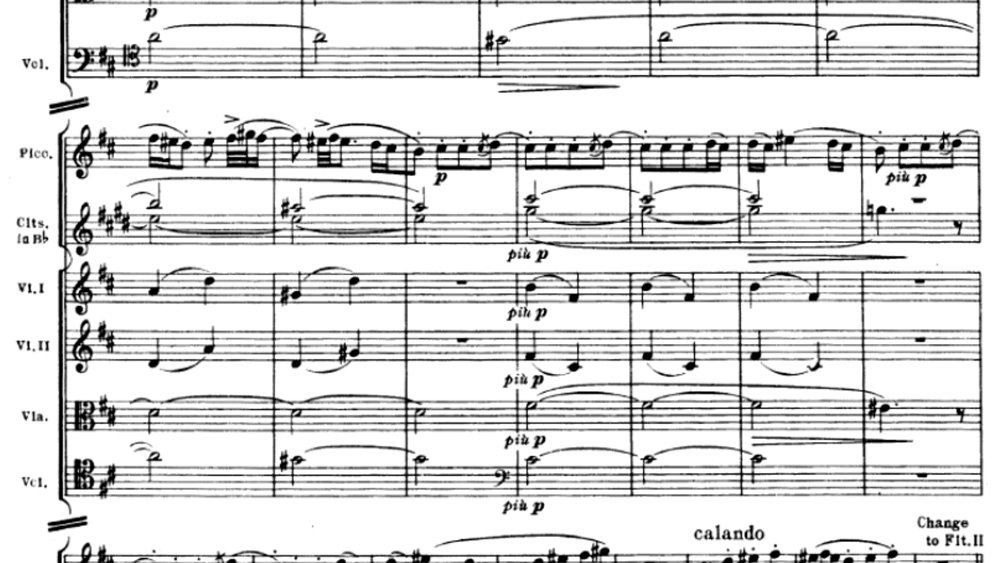
with a circular motion, we return to the beginning where the piccolo plays part of the first phrase and leaves everything suspended.
Rumanian Folk Dances n.4
Dance from Bucsum
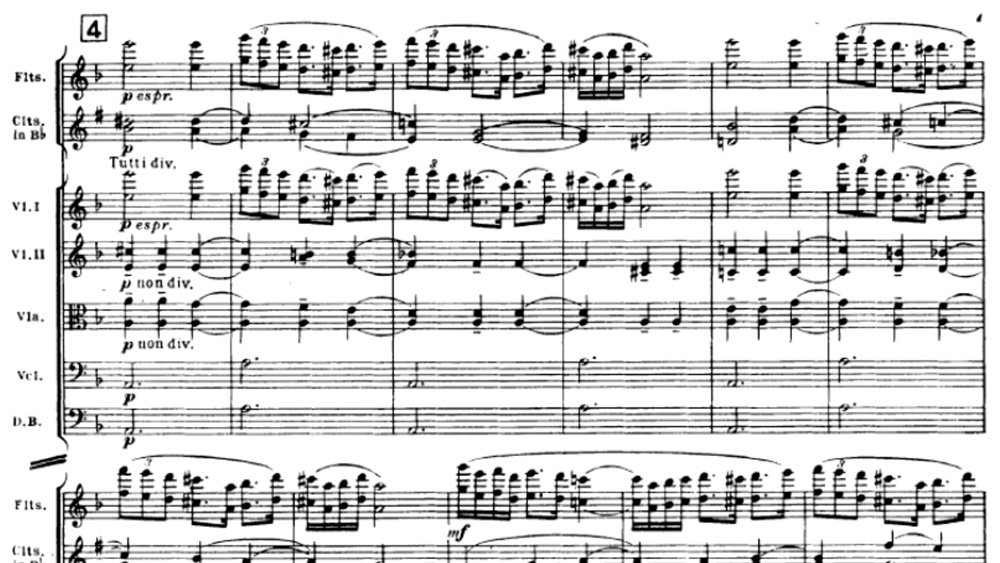
The fourth dance came from Bucsony - known also as the Dance of the mountain horn. Centered on a Phrygian A, it starts, once again, with the accompaniment by the violins, violas, and cellos. The melody comes in played by a solo violin, with a pizzicato of the double basses underneath

Notice that there are no dynamic changes or other indications until the end of the first part of this dance: on bar 14 we have crescendo-diminuendo markings in the cellos and double bass, while all the strings - minus the solo - are marked più' piano in the following bar.
The solo violin is pretty much free to move around on a constant accompaniment. Though notice the harmonic subtleties, like the chromaticism of the first violins in bars 7-8-9.
The second half of this dance simply retakes the same melody heard from the solo violin in the first part. Only, now it's played by all the first violins in octaves doubled by the flutes while the clarinets color the harmony
Rumanian Folk Dances n.5
Romanian Polka
The fifth dance is an old Romanian dance similar to the Polka and comes from Belényes near the border between Hungary and Romania.
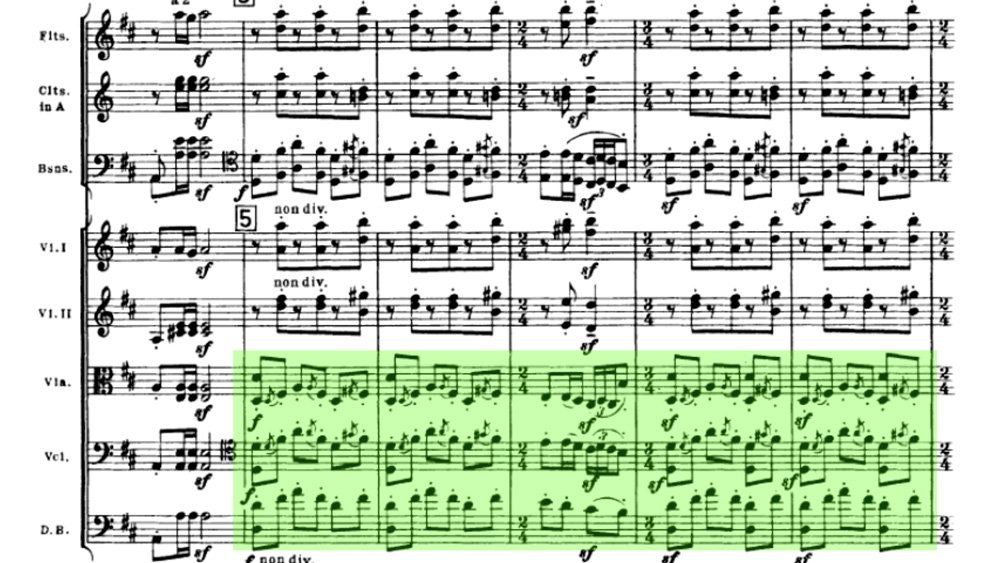
The Lydian D mode, the tempo indication of Allegro, and the offbeat sforzati at the end of the phrase: everything contributes to create a totally different atmosphere. I wouldn't define it as really joyful but we certainly picked up the pace.
Notice the offbeat accompaniment and the meter change moving from 2/4 to 3/4 and vice-versa for the whole duration of the dance, and the introduction of the bassoons

The structure is, once again, A-A1. The second time around the melody is picked up by the lower strings and the bassoons while the rest of the orchestra plays the accompaniment.
Take a look at the register in which the instruments are playing: violas in the low register, while bassoons, cellos, and basses are in the mid-high register. This creates a peculiar sound: rich but not heavy and still quite rough around the edges
Rumanian Folk Dances n.6
Fast Dance
The sixth and last dance is formed by two different melodies: the first one comes from Belényes and the second one comes from the then-named Nyagra village.
Notably, the horns are introduced here. The mode is Lydian and Mixolydian on an A center. Notice the dynamics: while the clarinets and bassoons are in crescendo, the violas, cellos, and double basses are in diminuendo. The tune is carried out by the violins in octaves

The tune is played a second time and we are connected to the last part of this suite, centered on a Dorian A. In a slightly faster tempo, the first violins play the melody on a hammering accompaniment. The structure of this phrase is mathematical: 4 bars in a 2+2 structure. Each 2-bars sections is connected by a flourishing scale in quintuplet of the flutes.
The answer is again 8 bars long and the first phrase is repeated. This time the flutes double the violins
Technical tip
While the first 4 dances need certain musical freedom in their approach, the last 2 are typical fast-paced folk tunes with all the offbeat accompaniments that normally come with them: technically, you need much smaller movements here, generally from your wrist. And try to emphasize the accents and the sforzato markings, which really do add a different nuance to the piece.
For a technical analysis, take a look at this other video
The second phrase is also repeated and it's used to close the suite in fortissimo


![Bruckner - Symphony 8 Movement 4 [Analysis]](https://gianmariagriglio.com/wp-content/uploads/2022/04/Bruckner-Symphony-n.8-Analysis.jpg)
0 Comments