

Introduction
In complete contrast with his 4th symphony - the Tragic - in 1816 Schubert approaches his 5th symphony with utter serenity. It is quite an unexpected work for the same Vienna that less than a decade earlier premiered the mother of all 5th symphonies, Beethoven's.
Schubert adopted almost an 18th-century model: he trimmed down the orchestra, using only one flute instead of the usual couple, no clarinets, no trumpets or timpani. Everything that could taint the color and the happiness of this work, or make it heavier, was stripped out.
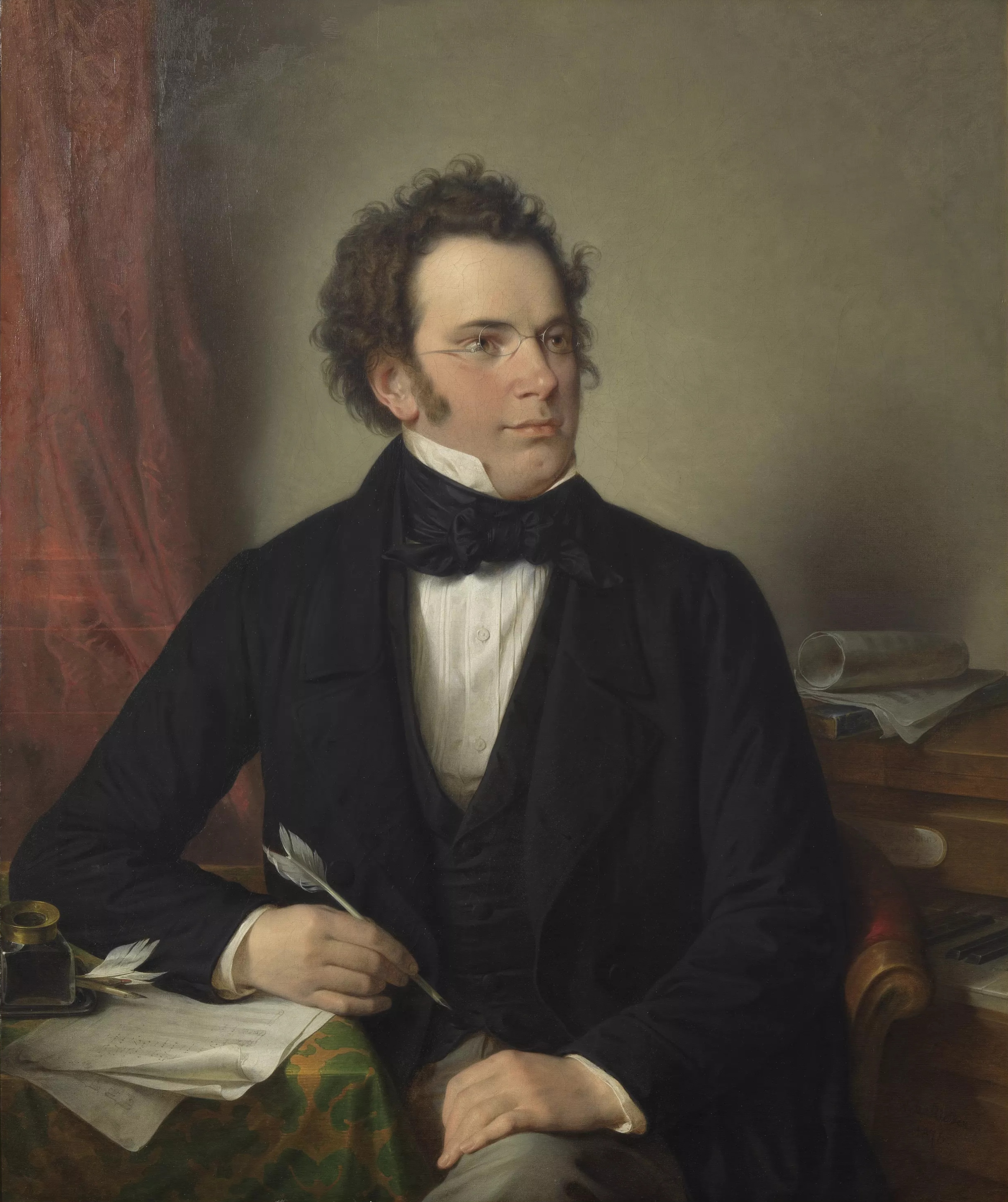
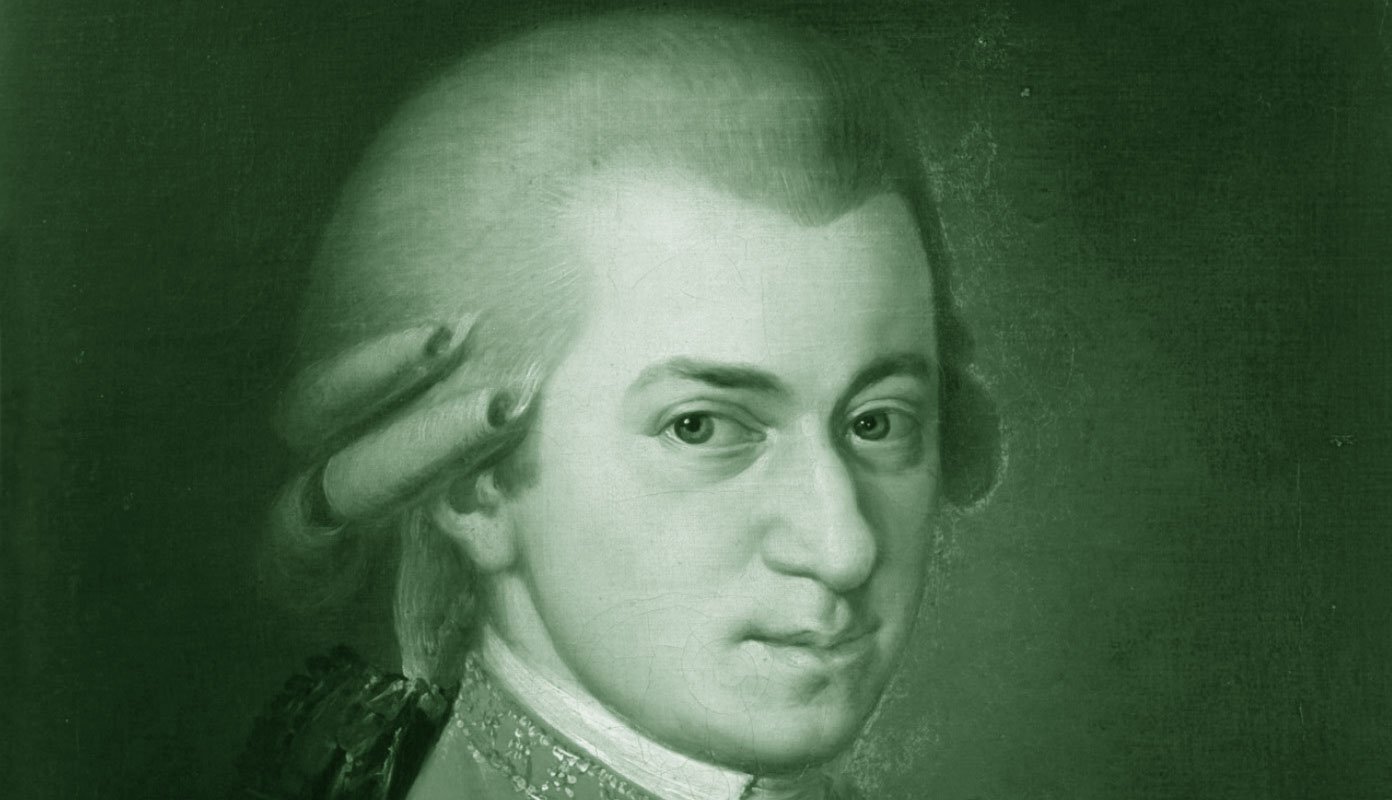
Franz Schubert - oil painting by Franz Schubert - oil painting by Wilhelm August Rieder (1825)
As Brian Newbould pointed out in his Schubert and the Symphony it was almost as "Beethoven had never lived"[1].
Mozart and Haydn, whose music had been part of Schubert's everyday life, are a clear reference for this symphony.

Allegro
Should you need a score you can find one here.
The first movement is in typical sonata form: an exposition with two contrasting themes, a development in which the material gets reworked, and a recapitulation.
In the classical era it was quite common to have a slow introduction at the beginning of a symphony. Mozart and Haydn certainly wrote their fair share of slow introductions, as did Beethoven. It was a way to catch the attention of the audience as well as introduce the first theme of the Allegro.
But different themes demanded different solutions: the opening statement of Mozart's K551 or Beethoven's 5th are so adamant they need no introduction. On the other hand, symphonies such as the "Prague" or the "London" needed a large introduction, while the first theme of Mozart's K550, the second G minor symphony, required that ¾ of a bar that makes it stand out (as an exercise, try to think about that movement without those few introductory notes and you'll see how much you would miss them).
Exposition
Mozart's K550 was certainly present in Schubert's mind.
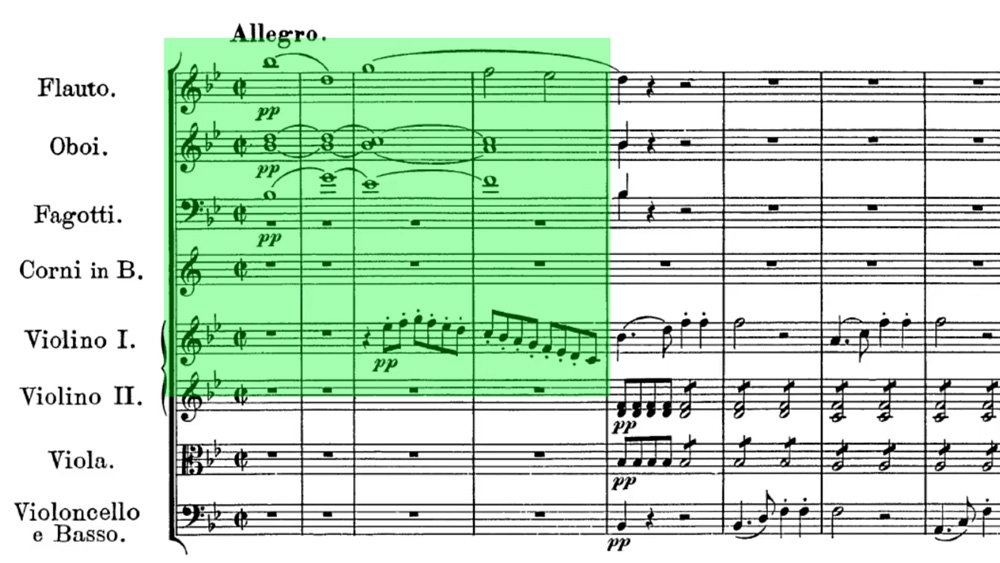
The "introduction" in this case lasts 4 bars, already in the Allegro tempo. And it is something that we will find quite a bit of in the development.
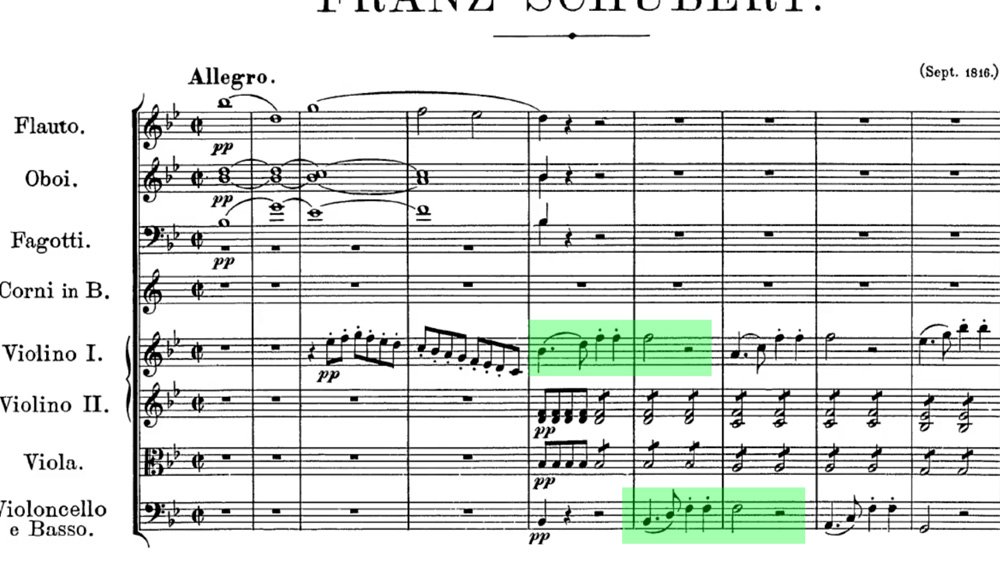
The first theme is set up by the first violins, echoed by the cellos. It's dancing, lighthearted, free from any of the worries of life.
Technical tip
Right from the start, this piece offers a number of opportunities to break patterns and have some pure conducting fun. At the very beginning, for example, you can:
- use your right hand for the woodwinds
- use your left hand for the 1st violin's entrance
- use a half circle for the slur followed by a short stroke for the short notes
- alternate left/right for violins/basses

For a full technical analysis, look up the video in the repertoire section
Notice this rhythmical element: it forms the base for everything that happens till the entrance of the second theme.
Small clouds pass through around bar 20, and the first theme is repeated, this time with an added flute counterline
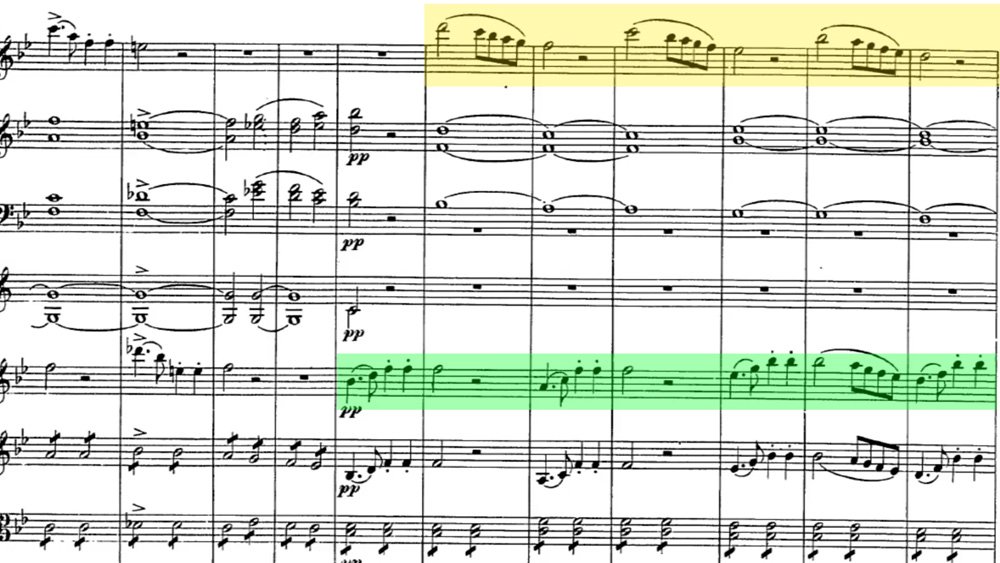
It's almost the same as the first time, except that on bar 34 we have one of those slight changes that gave Schubert a reputation of one of the most harmonically subtle composers of the 19th century: the bass remains on an Eb creating an Ab7 chord in its second inversion; in the second half of the bar, the 7th itself - the G - turns to a G flat, giving the whole passage a very peculiar color
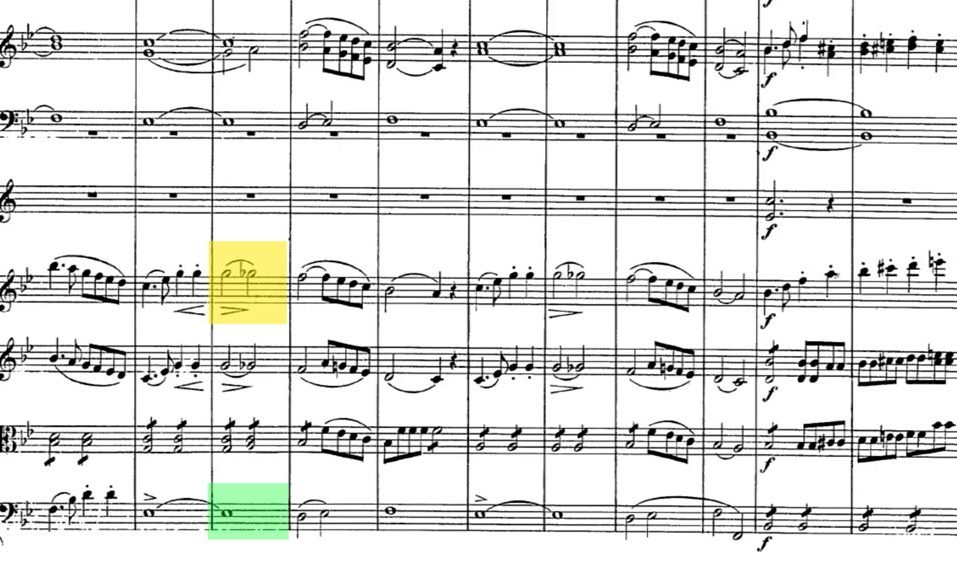
At the first forte, we see the rhythmic element of the theme taking a leap and propelling the phrase forward, again echoed by the cellos. The head of the cell, the dotted rhythm, is then used to come back to the same starting point
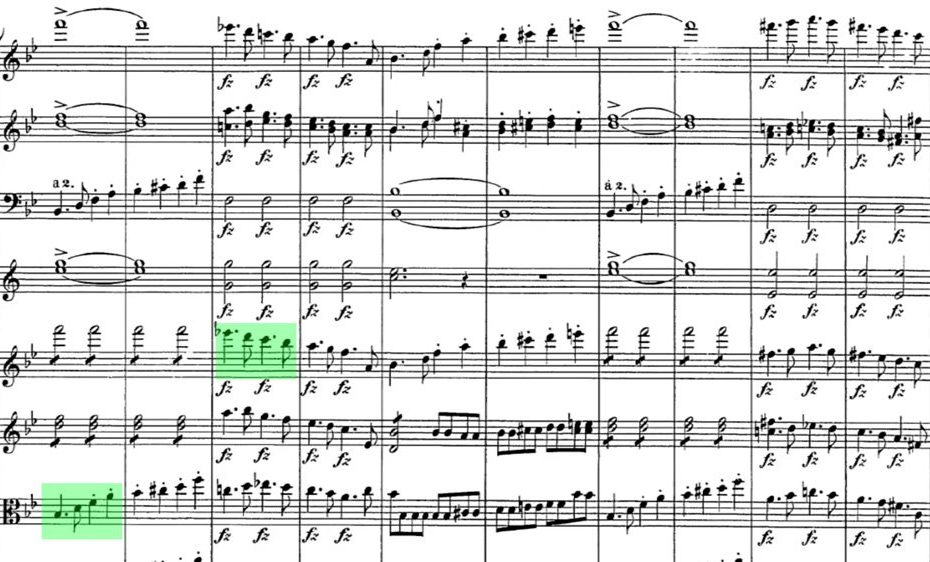
and subsequently to bridge to the second theme in a typically Mozartian harmonic modulation with the bass moving chromatically down and the upper line moving chromatically up.
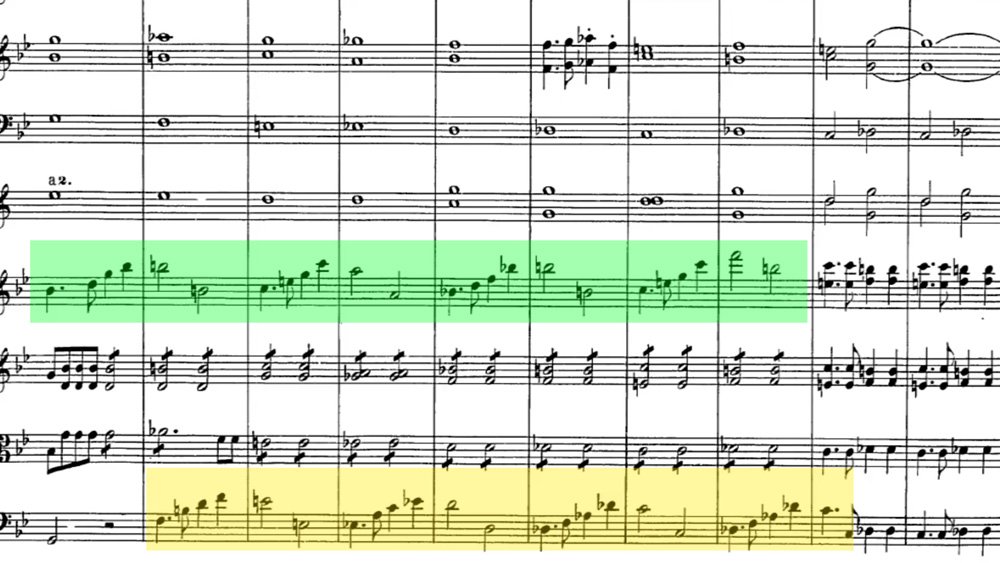
Notice how the second theme maintains a connection to the first in that dotted figure. This is a classic 8 bars phrase, in 4+4 succession
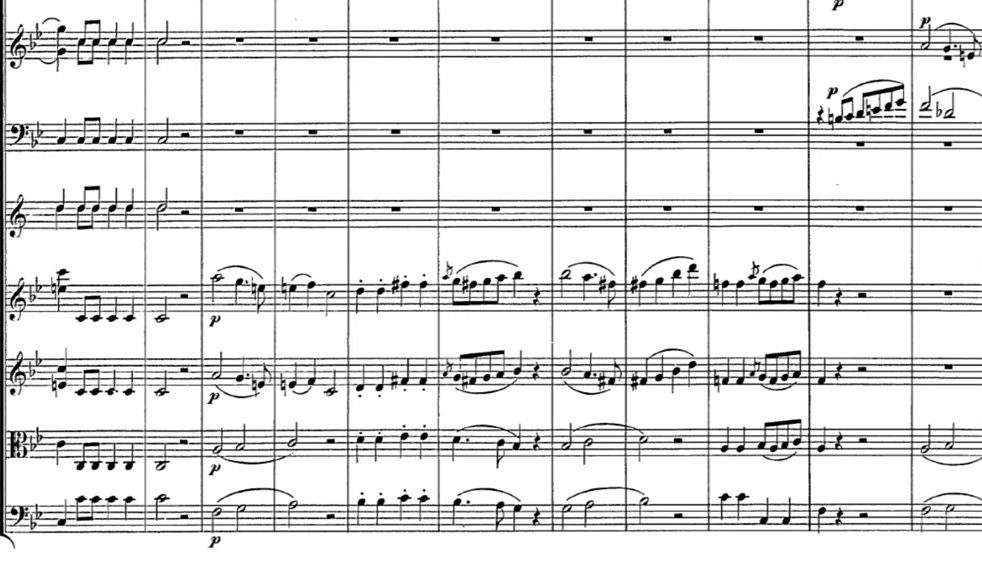
The repeat is rescored with the woodwinds, another echo of Haydn and Mozart. And then, the surprise: a deceptive cadence on a Db, the 6th of the scale. Using the chromatism the harmony turns into an augmented 6th on bar 84, leading back to F major.
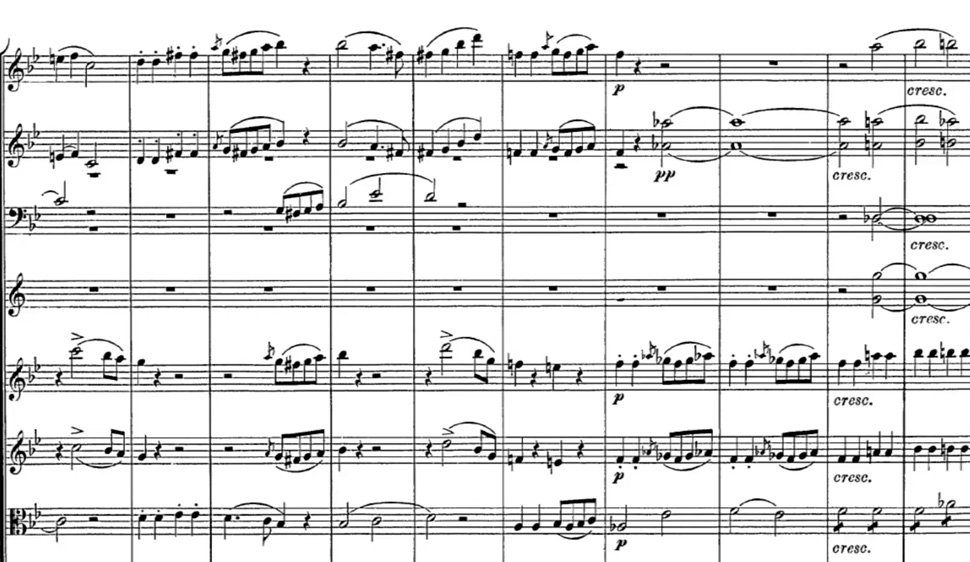
All of this leads to the end of the exposition. Notice the continuous back and forth between major and minor keys, and the insistence of the dotted rhythm
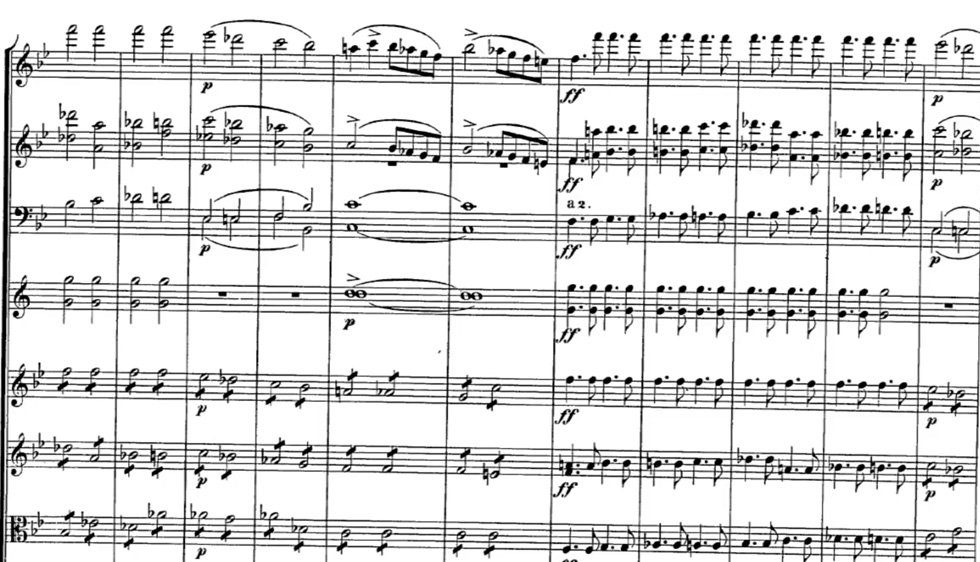
A final magical harmonic touch closes the exposition with a diminished 7th on a tonic pedal


Oops...
This content is available for free with all memberships.
Already a member? Login here.
Not a member yet? Subscribe today and get access to more than 80 videos, scores analysis, technical episodes, and exercises.
Development
The 4 introductory bars are back. The connection is severed by the rhythmic element that appeared in bars 110-111, which, in turn, is a version of the, now familiar, dotted rhythm. The 4 bars are repeated 4 times: the structure is the same, with the bassoons entering in the 2nd and 4th iteration. What changes is the harmony, moving down a third each time.
The rhythmic material is back in a modulating pattern as we get to the most dramatic moment, with the rhythmic element in the bass line and everyone playing forzato

The tension doesn't last long, the dynamic drops to piano though we're still wandering around, the harmony constantly shifting under our feet
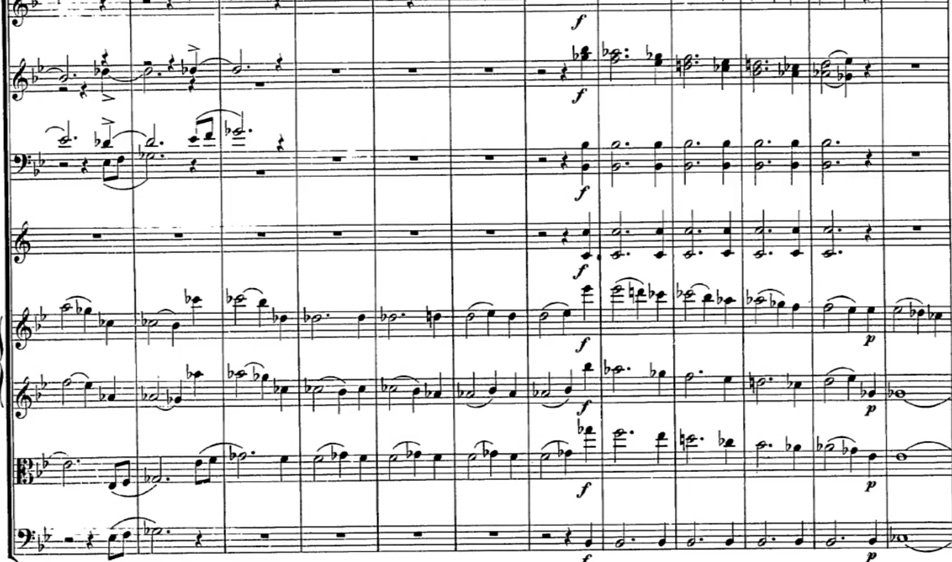
A final leap on a fp slides us into the recapitulation

Recapitulation
Unusual, in a way: the recapitulation doesn't start in the original key of Bb major but on its subdominant, the Eb.
Mind you, this is a practice for which Schubert, among others, has been accused of laziness: if you start the recapitulation from the subdominant you only have to transpose your transition material a 5th higher and you'll end up right on the home key for the second theme. No-fuss.
However, Schubert here does something more: at the end of the transition, on bars 215-230, he rewrites it almost entirely
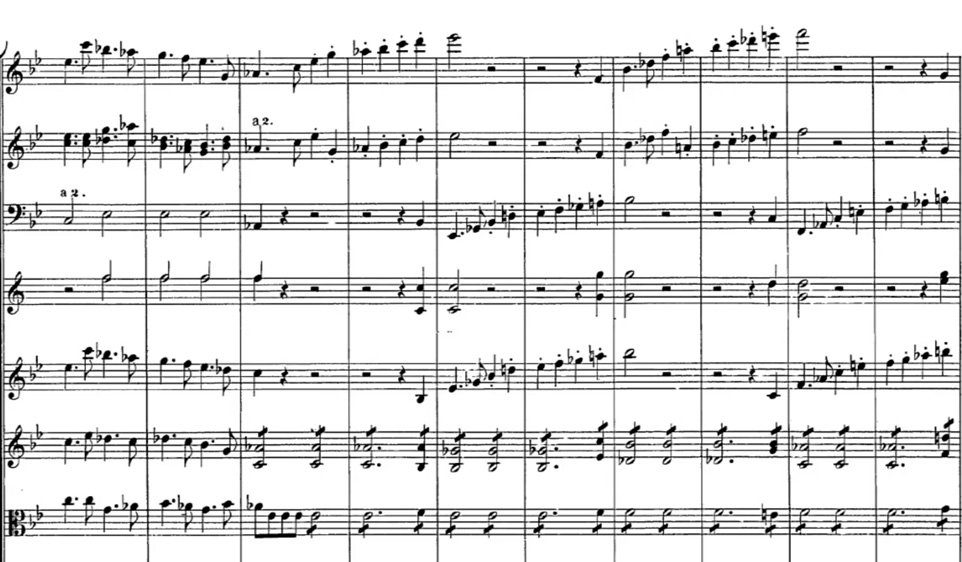
After this, the recap goes on by the book until bar 276 where Schubert cuts into the coda with a greatly joyful moment before going back to the closing material as in the exposition.
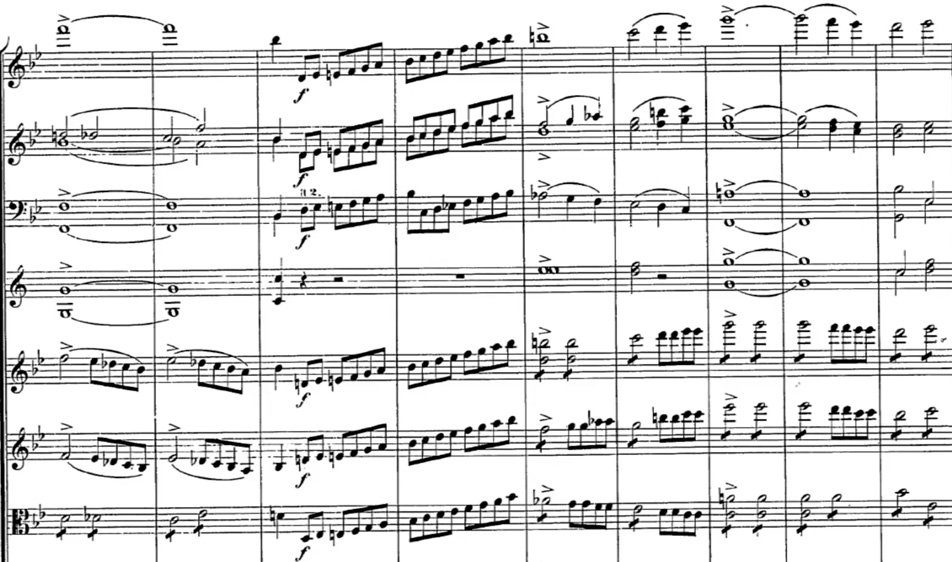
Incidentally, this is the same technique used by Mozart in ending the first movement of his symphony K550.

Andante con moto
The lovely melody, moving to a classical 6/8 meter and to the subdominant key of Eb, opens a movement that shies away from the sonata form, going for an extended ABA form. Extended because the A and B blocks are, in fact, repeated, forming a final A-B - A1-B1 - A2-Coda structure.
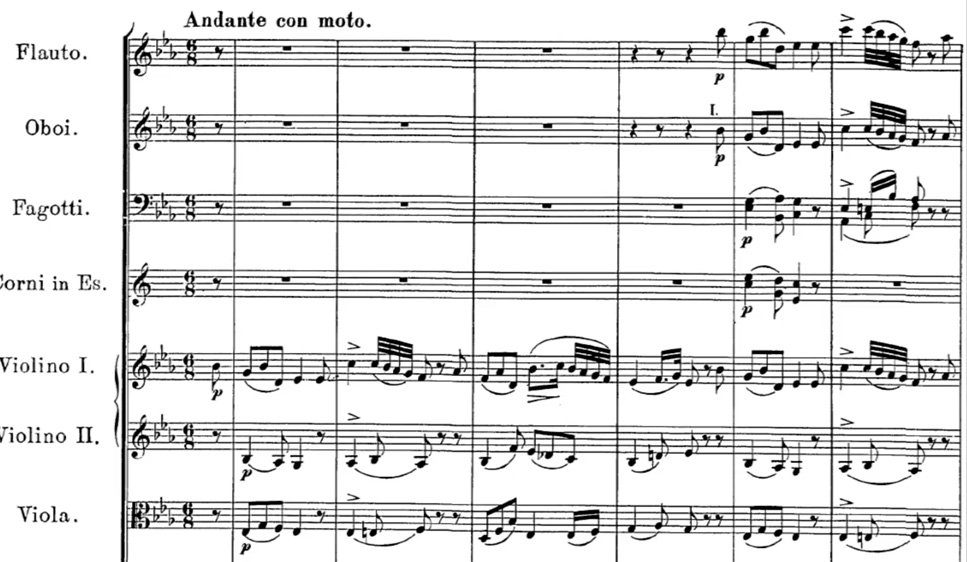
The 4 bars theme is exposed by the strings and doubled by the woodwinds
The second part of this first musical paragraph reiterates the dominance of the Eb major key. Notice though how, through the same material, Schubert adds those shadows we encountered in the first movement, underlining harmonic subtleties with offbeat accents
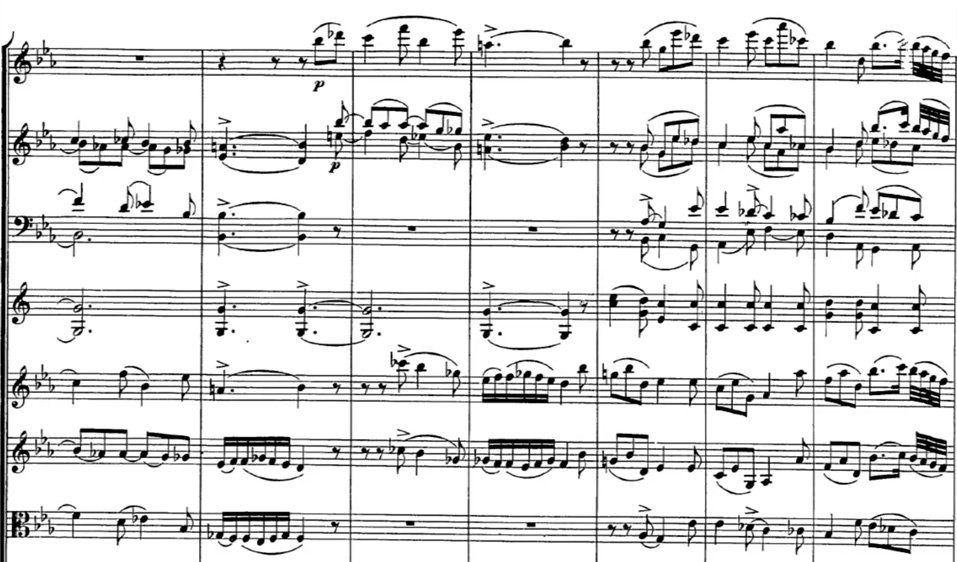
The B section starts in complete contrast with what we just left, with a wandering and daring Fb arpeggio
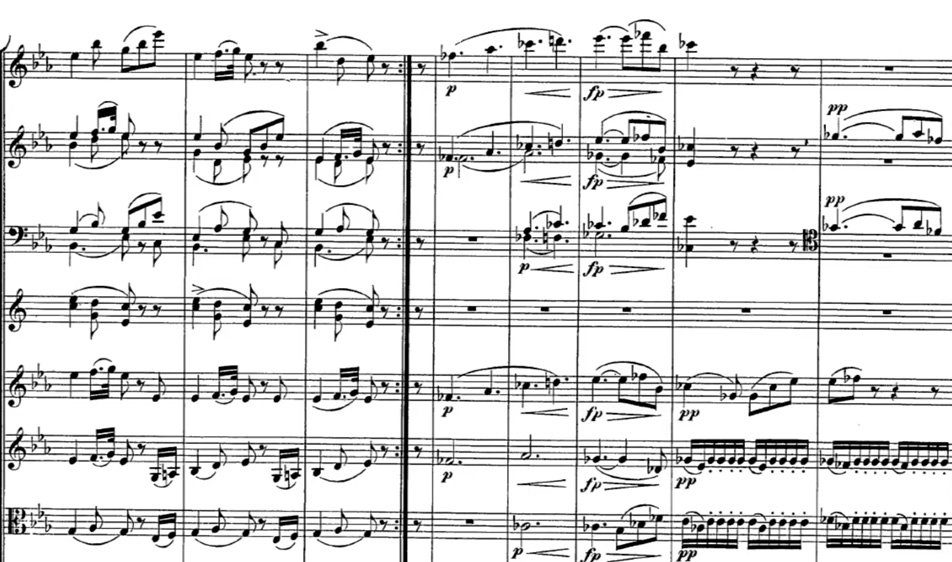
The idea is obviously related to the opening theme. The dialogue evolves, moving first to the flute and bassoon-fist violins and then including the entire woodwind section. Three bars later we land on a desperate G minor, enhanced by the entrance of the horns

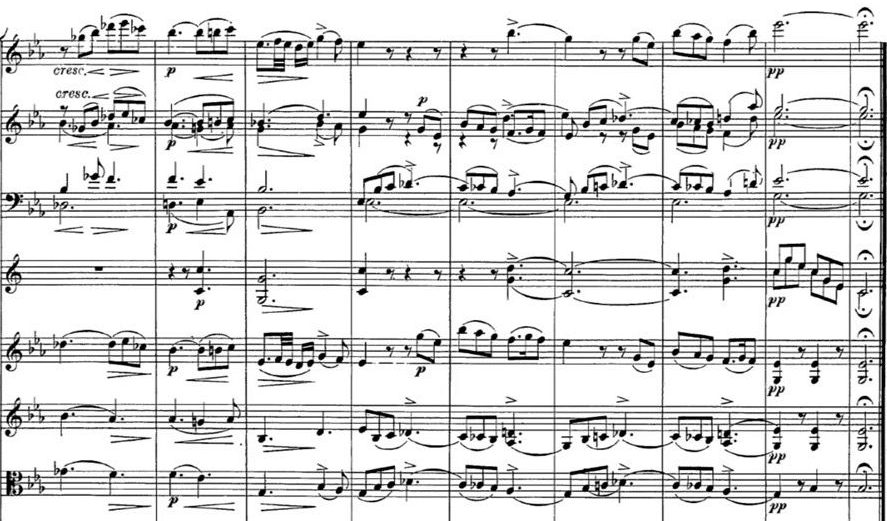
Schubert could have easily moved back to the A section here, as moving from G minor to Eb major is quite an easy step. Instead, he takes his time, indulging in an additional passage that sees the same chromatic motive moving from section to section till we finally land back on Eb and the reprise of the theme
The A section is repeated in its entirety with some embellishment and lands on the B section which, this time, is Gb instead of Cb

This section is shorter in returning to the home key and only the first part of the A section is repeated, landing on the coda, which closes the movement with a beautiful and warm arpeggio of the horns
Notes
Newbould, Schubert and the Symphony: A New Perspective, pp.110-111


![Bruckner - Symphony 8 Movement 4 [Analysis]](https://gianmariagriglio.com/wp-content/uploads/2022/04/Bruckner-Symphony-n.8-Analysis.jpg)
0 Comments